
- Product Name
- CasNo
- MF
- MW
- Content
- Appearance
- Packing
- Apply
- 933A |90212-84-3 99%
- 90212-84-3
- C15H14ClNO3S
- 323.8
- 99%
- Off-white to white powder
- 1kg/bag, 25kg/barrel
- brain health & cognitive function

Your Location:Home > 933A |90212-84-3 99%
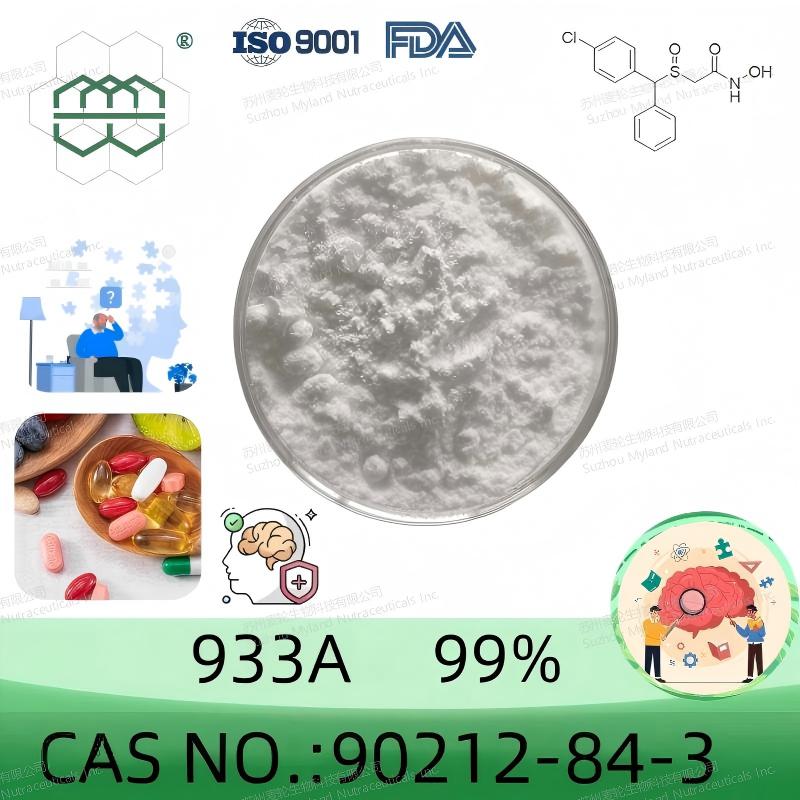
1. 933A CAS No.:90212-84-3 Antitumor and anti-inflammatory
|
Product name |
933A |
|
Other name |
Acetamide, 2-[[(4-chlorophenyl)phenylmethyl]sulfinyl]-N-hydroxy- |
|
CAS No. |
90212-84-3 |
|
Molecular formula |
C15H14ClNO3S |
|
Molecular weight |
323.8 |
|
Purity |
99% |
|
Appearance |
Off-white to white powder |
|
Packing |
1kg/bag, 25kg/barrel |
|
Application |
Dietary Supplement Raw Material |
933A belongs to the class of cross derivatives of hydroxamic acid and sulfoxides, and is commonly modified in medicinal chemistry as the scaffold for inhibitors of matrix metalloproteinases (MMPs) or histone deacetylases (HDACs). Its most significant application lies in serving as a lead compound for research and development of antitumor or anti-inflammatory drugs. The mechanism involves competitive inhibition of MMP activity by mimicking substrates, thereby blocking tumor cell invasion and metastasis or suppressing excessive inflammatory responses. The hydroxamic acid structure also constitutes the core scaffold of HDAC inhibitors (e.g., the well-known SAHA, fulinotamide). Consequently, this compound provides a valuable structural basis for designing multi-target drugs that inhibit both MMPs and HDACs.
1) Physical properties: appears as white or off-white crystalline powder. Due to the presence of polar groups, it exhibits good solubility in dimethyl sulfoxide (DMSO) or alcohols, but low solubility in non-polar organic solvents. Storage under low temperature, dry conditions, and protected from light is generally recommended to prevent oxidation or degradation of the hydroxamic acid groups.
2) Stability: This compound may be sensitive to metal ions (particularly iron or zinc ions), and complexation reactions upon contact with metals may lead to structural alterations.
1. Chemical tools: In biochemistry, they can be used to study the interaction mechanisms between enzymes and substrates or serve as positive controls to verify the reliability of enzyme activity detection systems;
2. Antitumor : The hydroxamic acid group can chelate zinc ions at the active site of MMPs, rendering them inactive and thereby inhibiting their invasiveness and metastasis;
3. Anti-inflammatory: They prevent immune cells from readily crossing vascular walls and the extracellular matrix (ECM) to reach inflammatory sites and release additional inflammatory mediators, thus controlling excessive inflammation spread.
WANT TO PURCHASE I 我要采购
Please contact us and we will get back to you as soon as possible
